
In 2019 I became an ambassador for Tormek, a Swedish company founded in 1973 and based in Lindesberg, which makes water-cooled sharpening machines. One of the things that makes Tormek special is its wide range of jigs, making it much easier to sharpen your tools. If you take care setting up the jig, you get a sharp edge. With practice — and a fair few mistakes — the machines also work very well for freehand sharpening.
In the summer of 2019 I had the idea of becoming a modern travelling sharpener, and Hällekis by Kinnekulle became the place to test it. I never expected it to be so popular. People came in great numbers to chat, look at the machine and share childhood memories of the sharpener visiting their village. The range of things people wanted sharpened was remarkable too, from kitchen knives to samurai swords. Below is an article reproduced from Hällekis-Kuriren, 6 July 2019: www.hallekis.com
Unfortunately, I did not end up living in the Stone Age hut mentioned below: it was declared unsafe because some roof timbers had rotted.
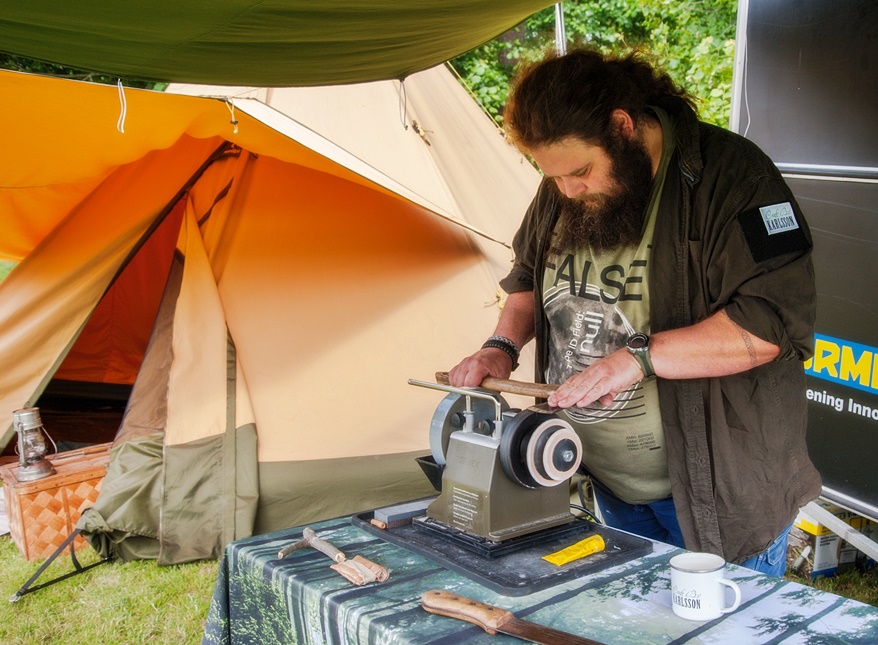
Tobias sharpens knives in Hällekis using solar power
Just south of Hällekis station, an orange tipi tent has appeared at one end of Christian’s garden. Tobias Karlsson is spending a few days here, sharpening knives, axes and scissors with solar power for anyone who wants sharp tools.
Tobias, who runs Craft by Karlsson, comes from Kristinehamn in Värmland. He has been sharpening for about 30 years and working professionally for the last few. He is largely self-taught but has trained on the machine he now uses. Solar panels on the trailer roof generate its electricity. He says he may be the only person in the country working this way.

He does not usually stand in one place sharpening like this. More often he is at fairs teaching people how to use the machine, as well as running various courses. Recently he attended a bushcraft festival in Estonia, with which he collaborates, running workshops and other activities. The Estonians also visit Sweden for a similar festival here. Tobias says they are fantastic craftspeople because the old traditions remain alive, largely because under former Soviet rule people often had to make things themselves when they could not buy them.
Tobias has lived as a modern nomad for about a year. He bought a trailer with solar panels and fitted it out with a mobile office and all the equipment he might need to work outdoors throughout the year. He lives in a modern tipi tent, with a stove when needed.
In the autumn he will go to Sveg for a year at Bäckedal Folk High School, taking a course called “Human, Nature, Technology”, which includes ancient knowledge and unusual crafts. During his studies he plans to live in a Stone Age hut designed for winter. Afterwards, he hopes to be accepted onto a course in the USA. There are only four places, but he says his chances currently look quite good. He describes himself as a sponge for knowledge, always wanting to learn more so that he can pass it on.
Tobias picks up an axe and begins sharpening it. The machine runs very quietly.
“What is the hardest thing to sharpen?”
“Something called a V-tool,” Tobias says, describing a carving tool with several angles. “You use a jig. Getting the angle right is difficult, but once that is done, sharpening is easy.”
The idea behind Craft by Karlsson is to offer high-quality training and courses, mainly in simpler forms of outdoor life, with more focus on experience and interaction than on bought equipment.
Tobias believes Hällekis and Kinnekulle, with so much outdoor activity — hiking, cycling, boating and more — would be a perfect place for a future bushcraft/outdoor festival, something timely that he thinks would attract many people.
Leave a Reply
You must be logged in to post a comment.